Lakha Mandal Shiv Temple
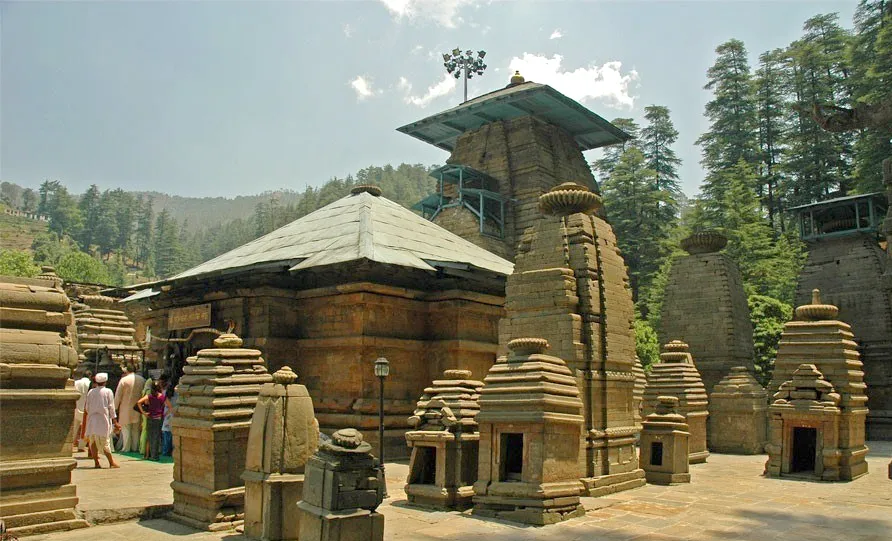
The Lakha Mandal Shiv Temple is an ancient, historically rich Hindu temple complex dedicated to Lord Shiva, located in the Jaunsar-Bawar region of Dehradun district, Uttarakhand. Situated beside the flowing Yamuna River, this protected monument under the Archaeological Survey of India (ASI) derives its name from “Lakha” (many/one lakh) and “Mandal” (zone/shrine). This highlights the thousands of ancient Shivalingas and stone carvings discovered scattered across its premises.
🔱 Mahabharata Lore & Mystical Legends
- The Lakshagriha (House of Lac): Local folklore strongly links this site to the epic Mahabharata. It is believed to be the exact location where Duryodhana constructed the flammable Lakshagriha (wax house) in an attempt to burn the Pandavas alive. The Pandavas survived by escaping through a nearby secret cave network known locally as Dhundhi Odaari.
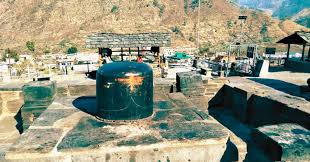
- The Shimmering Graphite Lingam: The main attraction in the temple courtyard is a unique dark graphite Shivalinga. When water is poured over its smooth surface, it turns highly reflective and mirrors its mountain surroundings like a dark crystal mirror.
- The Mystery of Danav and Manav: Flanking the courtyard are two towering stone gatekeeper statues. While local myth identifies them as the Pandavas Bhima and Arjuna, ASI inscriptions tie them to Jai and Vijay, the celestial doormen of Lord Vishnu. Local legend holds that any freshly deceased body placed before these guard structures would briefly return to life long enough to consume holy water before peacefully passing on.
🏛️ History & Architectural Design
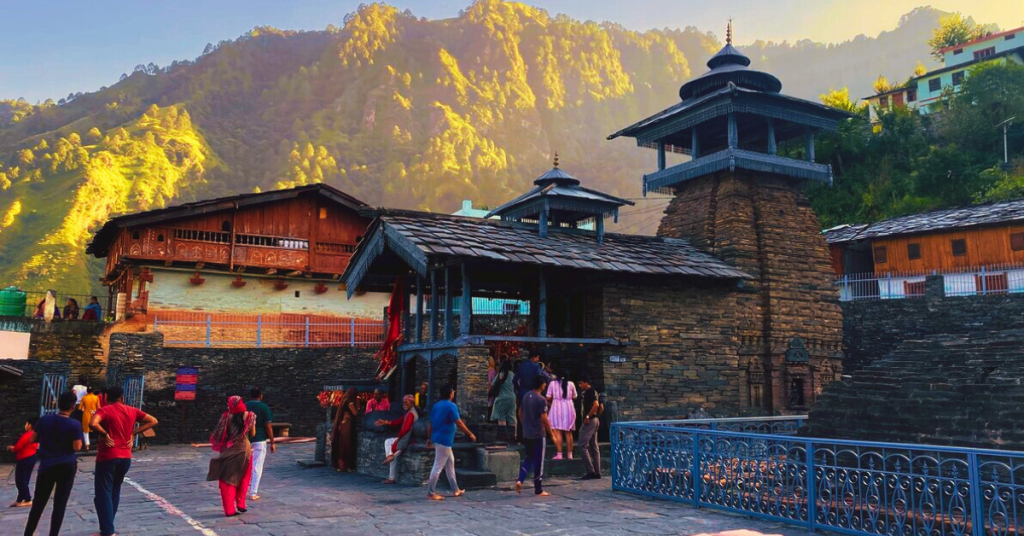
- Nagara Style: The surviving stone temple complex exhibits the classical North Indian Nagara style of architecture, highlighted by its towering Shikhara pyramid structure.
- Historical Age: While structural ruins at the deeper base layers date back to the 5th–8th centuries CE, the main temple layout seen today was erected around the 12th to 13th centuries CE.
- Royal Foundations: A prominent 6th-century stone inscription excavated at the site attributes a major structural phase to Princess Ishwara of the Singhpura royal family. She built a grand temple here to ensure the spiritual welfare of her late husband, Prince Chandragupta.
🗺️ Location & Travel Logistics
The temple is highly accessible by road and does not require intense mountain trekking.
- Distance: Situated roughly 128 km from Dehradun city center and 35 km away from the hill station of Chakrata, directly along the scenic Mussoorie-Yamunotri highway route.
- Timings: Open to pilgrims and general visitors daily from 6:00 AM to 6:00 PM. Entrance to the ASI heritage complex is free.
- Best Time to Visit: October to March brings clear skies and pleasant weather. Notably, the local tribal communities celebrate Boodhi Diwali here exactly one month after the main national festival, filling the valley with traditional folk dances and celebrations for a full week.
🗓️ Quick Destination Summary
| Feature | Travel & Ground Reality Details |
|---|---|
| Primary Presiding Deity | Lord Shiva (Mahamundeshwar Graphite Lingam) |
| Architectural Style | North Indian Nagara Style Architecture |
| Key Attraction | Thousands of ancient stone idols, carved reliefs, and Shivalingas |
| Nearest Railway Hub | Dehradun Railway Station (~107 km away via NH-507) |
| Nearest Airport | Jolly Grant Airport, Dehradun (~130 km away) |
🛕 The Structural Evolution of the Shrine
The main temple structure standing today is a layered architectural puzzle reflecting centuries of rebuilding.
- The Sub-Surface Brick Layer: Below the visible stone platforms, ASI structural analysis revealed ancient burnt-brick foundations dating back to the 5th century CE. This indicates that the Nagara-style stone temple was constructed directly over a much older, possibly Gupta-era religious platform.
- Architectural Blueprint: The standing 12th-century shrine follows a strict geometric layout featuring a square sanctum sanctorum (Garbhagriha), a small connecting vestibule (Antarala), and a pillared gathering hall (Mandapa) topped by a sharply tapered curvilinear tower (Shikhara).
- 2026 Active Facelift: Because centuries of heavy Himalayan rainfall loosened the joints across the stone-slab roofing, the ASI initiated an extensive restoration project in May 2026. Engineers are systematically numbering, dismantling, and reassembling every single slate piece to waterproof the inner sanctum.
🎨 Cultural Traditions & Tribal Festivals
The temple acts as the primary spiritual anchor for the local Jaunsari and Bawar tribal communities of the Dehradun hills.
- The Jagra Festival: Held annually in September, the highly energetic Jagra festival involves staying awake all night to sing traditional folk epics and carry the temple’s heavy metal festive idols down to the Yamuna River banks for a ceremonial bath.
- The Bovine Hoofprints: Inside the stone floor blocks of the inner mandapa, you can spot small, naturally worn indentations. Local heritage stories attribute these to the hoofprints of a mythical cow that allegedly discovered the buried lingam by spilling her milk over the hidden stone mound every afternoon.